

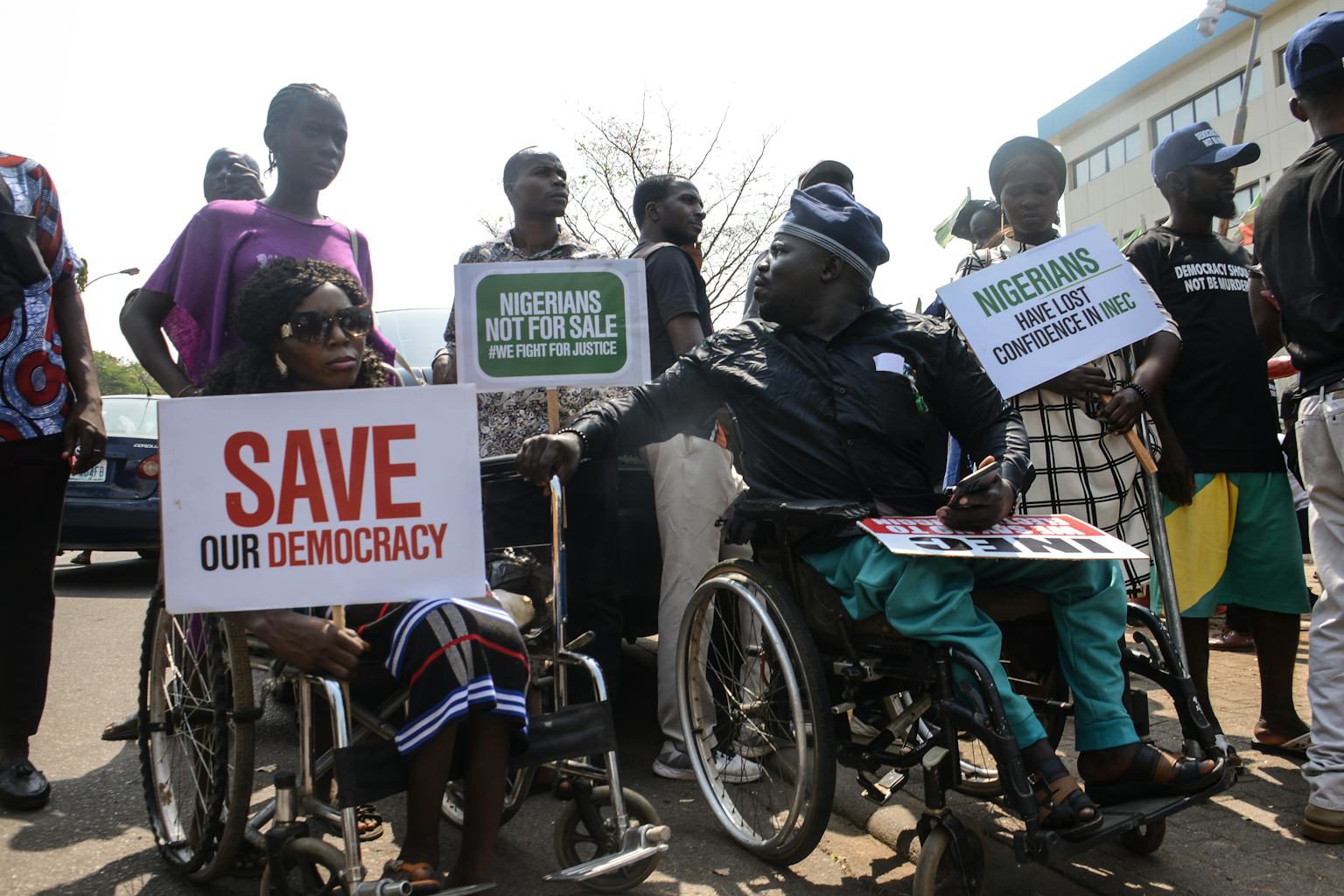
Nigeria has built an impressive legal framework for disability rights. The challenge now is turning these commitments into consistent, lived realities for voters with disabilities. With elections in 2027, the country has an opportunity to show others what full electoral inclusion looks like.
Across Africa, citizens with disabilities continue to face barriers to voting, from high staircases and narrow doorways to uninformed officials and ballot papers they cannot read. Yet democratic participation is not a privilege. It is a right guaranteed under Article 29 of the UN Convention on the Rights of Persons with Disabilities.
Nigeria, Africa’s largest democracy, has taken bold steps to protect that right. This includes its Discrimination Against Persons with Disabilities (Prohibition) Act 2018.
Our research examined the experiences of people with disabilities during the 2019 elections. We found that challenges of braille ballot papers, transport restrictions and stigmatisation adversely affected their voting participation.
Since that election the government has enacted the Electoral Act 2022. This establishes some of the continent’s strongest guarantees for equal political participation.
Our follow-up research, which examined Nigeria’s 2023 elections, shows that new legal and institutional frameworks improved disability accessibility and participation. Gaps in implementation, staff training and polling-unit accessibility persist, however. The study outlines some ways to fill those gaps.
Put together, our research shows that Nigeria’s problem is not the absence of policy but the gap between commitment and execution. Laws must be translated into daily practice.
With credible data, structured training and genuine collaboration between the Independent National Electoral Commission and key actors, Nigeria can transform the 2027 elections for disabled people.
This article offers recommendations for enhanced inclusion of disabled people and for closing the disability gap in future elections.
What our research shows
Our research found both progress and gaps.
Since 2018, the Independent National Electoral Commission has become more proactive. It created a Framework on Access and Participation for Persons with Disabilities, produced braille ballot guides, provided magnifying lenses and sign-language materials, and worked closely with disability organisations such as the Joint National Association of Persons with Disabilities.
Field interviews and focus-group discussions confirmed that assistive devices reached more polling units and that voters with disabilities were often given priority in queues.
Our follow-up research on the 2023 elections shows further improvement. The electoral commission’s engagement with disability groups became more systematic, priority voting was more consistently applied, and assistive tools were distributed more widely than in 2019. These changes helped more disabled voters participate.
Yet inclusion remains uneven. Our research shows that many polling units in both the 2019 and 2023 elections were inaccessible to wheelchair users. Some officials did not understand how to deploy assistive tools. Blind voters frequently reported receiving braille guides without prior orientation. And, most critically, the commission still does not maintain a reliable database of where voters with disabilities live. So materials are mis-allocated, and needs go unmet.
How other African democracies compare
Nigeria’s experience mirrors a broader continental challenge.
South Africa has gone furthest in implementing inclusive voting. The Independent Electoral Commission uses a universal ballot template that enables blind and low-vision voters to cast a secret ballot. It also allows advance voting for people with mobility impairments.
But challenges were still evident. These included getting information, staff training, physical access to polling stations, privacy, and availability of the ballot template.
Ghana follows closely. The Electoral Commission and partners such as Sightsavers and the Ghana Federation of Disability Organisations have institutionalised the Tactile Ballot Jacket, which embeds accessible voting into routine electoral administration rather than treating it as an ad-hoc arrangement.
They have also trained thousands of visually impaired voters and polling officials. Observation reports from the 2020 and 2024 elections found most centres accessible and procedures orderly.
Limitations were also reported, from polling station access to voter education and training of election officials.
Kenya has strong constitutional and legal frameworks but inconsistent delivery. Accessibility remains concentrated in urban areas, and data relating to disability is scarce.
Compared with these countries, Nigeria ranks high on legal ambition but low on operational consistency. The lesson from South Africa and Ghana is clear: sustained training, accurate data management, and collaboration with disability organisations are what works.
Bridging Nigeria’s inclusion gap before 2027
Nigeria should make six key reforms:
- Map and publish disability data
- Audit accessibility well before election day
- Train every official
- Standardise assistive tools and make them available in all states
- Include people with disabilities as polling officials, party agents and accredited observers to normalise participation
- Expand accessibility across the entire electoral cycle, from campaign materials and party manifestoes to voting and post-election information.
These measures are feasible within Nigeria’s existing electoral structure, and the ongoing overhaul of the Electoral Act offers a timely opportunity to strengthen alignment.
Changing attitudes: from charity to citizenship
Our research further showed that many Nigerians still interpret assistance to voters with disabilities as an act of kindness rather than a constitutional obligation.
Some polling officials described priority voting as a gesture of sympathy. Such attitudes reinforce the outdated charity model of disability and undercut the human-rights model embedded in Nigeria’s laws.
True inclusion means recognising persons with disabilities as equal citizens whose participation strengthens democracy itself. When accessible ballots, ramps and trained staff are in place, the message is powerful: every citizen counts.
Dr Afeez Kolawole Shittu, Political Science lecturer at the Federal College of Education (Special), Oyo, Nigeria is co-author of research underpinning this article and the article.
Temitayo Isaac Odeyemi, Research fellow, International Development Department, University of Birmingham
This article is republished from The Conversation under a Creative Commons license.
