

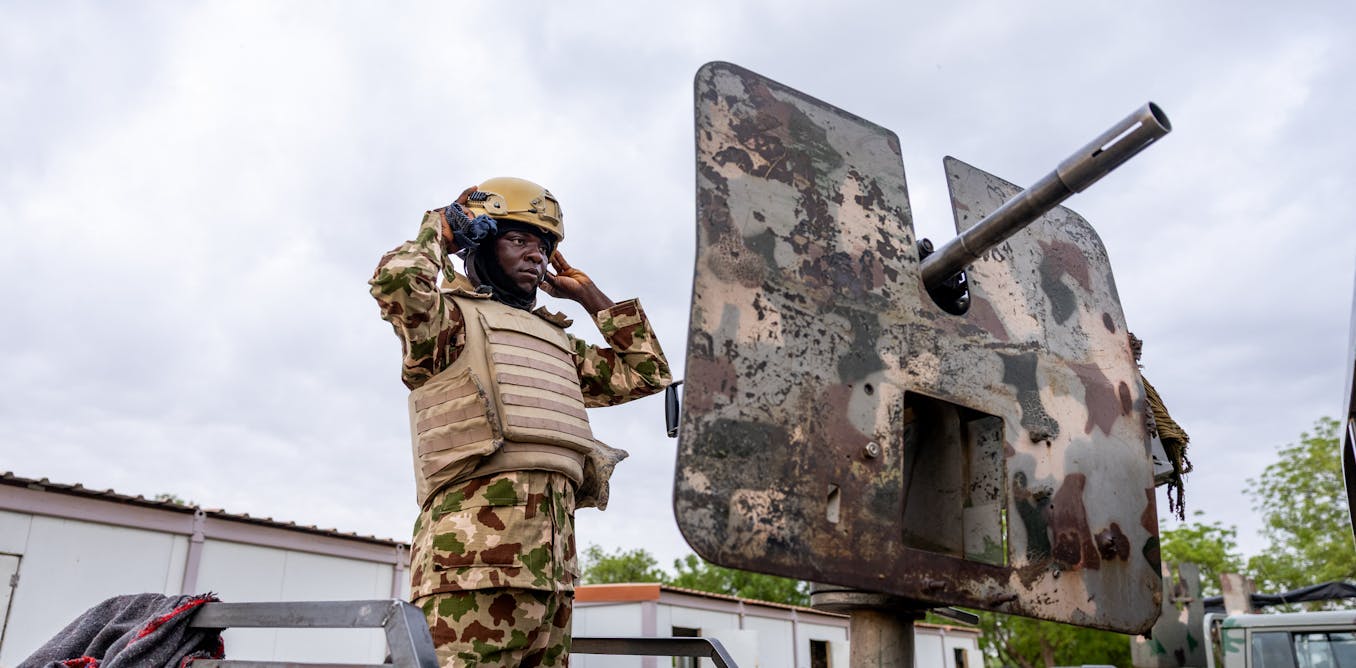
The killing of Nigeria’s Brigadier General Musa Uba, in mid-November 2025, by the Islamic State West Africa Province, ISWAP, risks boosting the morale of insurgents while demoralising Nigerian troops fighting insurgency.
The rank of brigadier general is one of the highest in the military. A brigadier general typically commands a brigade, which consists of approximately 4,000 troops. Uba was the commander of the 25 Task Force Brigade in Damboa local government area of Borno State.
The death of an officer of this rank isn’t unprecedented. But it is rare. Brigadier General Zirkushu Dzarma was killed in November 2021 with four other soldiers when ISWAP rammed a bomb-laden car into his official vehicle.
Uba’s case differs, however. He was captured – and then killed – during active engagement with the insurgents.
The circumstances around his capture and killing provide insights into two aspects of Nigeria’s security challenges. The first is that it tells us a great deal about technological adaptability of ISWAP. The second is that it highlights the weaknesses in Nigeria’s counter-terrorism efforts.
I am a scholar researching terrorism and counter-terrorism in the Lake Chad region and I have been studying ISWAP’s terror activities and Lake Chad countries’ response.
Based on this work I would argue that the capture and killing of Brigadier General Musa Uba shows two things. First, it points to ISWAP’s increased capability in rapid intelligence, surveillance and reconnaissance. Secondly, it underscores poor coordination between Nigeria’s military authority and counter-terrorism units, as well as poor technological improvements despite increased defence spending.
Accounts of what happened
According to media reports, Brigadier General Uba led his troops, along with members of the Civilian Joint Task Force, on a routine patrol in the ISWAP-dominated area of Damboa on 14 November 2025. They encountered an ambush by ISWAP around Wajiroko village. Two soldiers and two civilian task force members were killed.
The brigadier general managed to leave the point of attack but became separated from the forces and found himself alone in ISWAP territory.
He began coordinating his rescue using WhatsApp on his personal phone. As his WhatsApp messages published in the local media revealed, he had agreed with the rescue team on what to do and how to proceed. A helicopter was reportedly deployed to locate and rescue him, but he could not be found.
Three days later, ISWAP said it had captured and killed him. In its media outlet, Amaq, it claimed that as soon as it had received intelligence about the brigadier general, it deployed a group of fighters to search for him.
A key question this raises is: how did ISWAP determine Uba’s location while the army rescue team couldn’t?
I think that technology might have aided ISWAP in quickly detecting his hideout. This is based on evidence that shows ISWAP’s growing use of technology to enhance its activities in recent years. For example, it’s now using drones for intelligence, surveillance, reconnaissance and attacks. In 2022 it released video of military camps and vehicles it filmed using drones to spy on the Nigerian army and the Multinational Joint Task Force in Wajiroko.
How the military responded
News broke in the local media in the early hours of 16 November that the brigadier general leading the ambushed troop was missing. This suggested that ISWAP might have kidnapped him.
The military leadership in Abuja rebutted the news, explaining that the troops were able to fight back and force the terrorists to withdraw. They also debunked the news of the abduction of the brigadier general by ISWAP, saying he successfully led troops back to base.
ISWAP said it had captured him on the morning of 15 November. The Nigerian Army leadership released their rebuttal around 1pm the same day.
Either the military leaders were deliberately covering the truth, or they were not in close and reliable contact with their counter-terrorism units.
This raises questions about communication between the military authority and various units which leads to the issue of the battlefield communication between troops and military authority.
In contemporary warfare and counter-terrorism, troops ought to wear a Global Positioning System (GPS) device attached to their uniforms or equipment.
GPS is one component of the broader positioning, navigation and timing system, which constantly transmits the locations of troops. If something goes wrong, commanders or rescue teams can quickly see exactly where they are without waiting for calls or searching blindly.
This appears not to have been the case.
Between the evening of 14 November, when the troops were ambushed, and early in the morning of 15 November, when the brigadier general was captured, Nigerian military leadership could not evacuate him from the dangerous location despite the short distance of 88km between Maiduguri, the headquarters of Operation Hadin Kai, and Damboa.
The most likely explanation for this is that it didn’t have the necessary intelligence to do so.
This raises the question of whether Nigeria’s military has been investing enough in its technological capabilities. The country invests heavily in the military. In the 2025 budget, 6.57 trillion naira (US$4.5 billion) – about 12.45% of the total budget – was approved for security and defence. The question is whether this money is being spent in ways that equip the military to fight ever-more sophisticed insurgency groups.
With the gradual shift in terrorism and counter-terrorism towards a technology war, the Nigerian military authority must understand that investing in technological capabilities, including tracking technology, is not a luxury. It is a necessity.
Saheed Babajide Owonikoko, Researcher, Centre for Peace and Security Studies, Modibbo Adama University of Technology
This article is republished from The Conversation under a Creative Commons license.
