

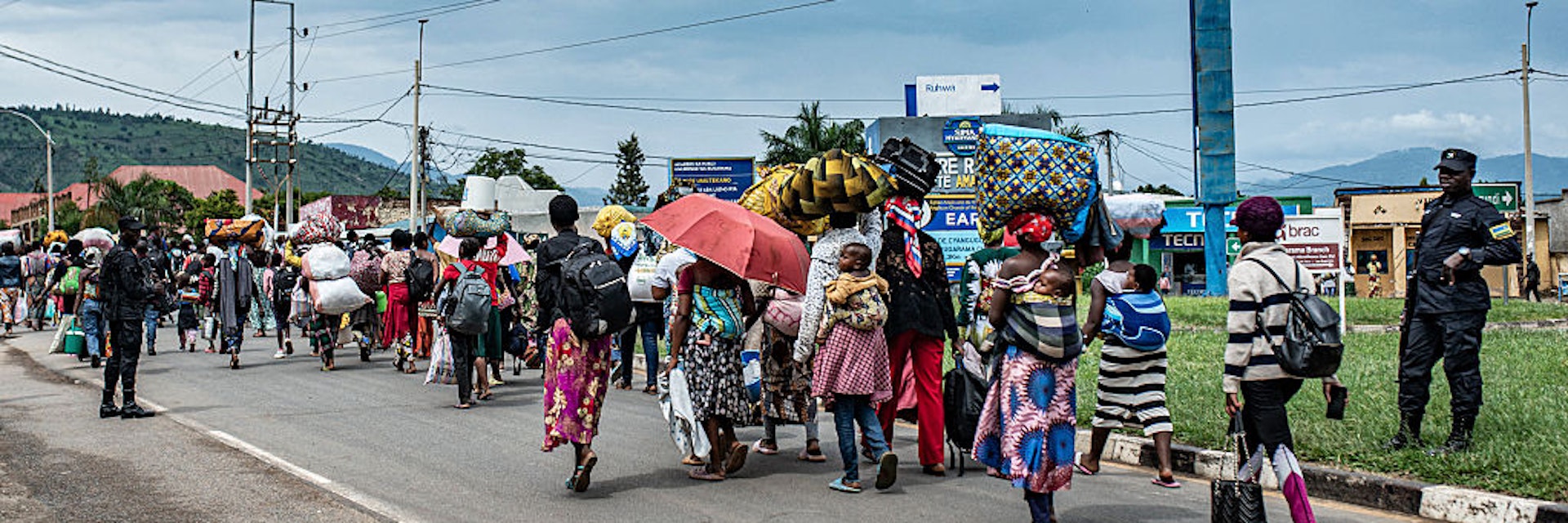
Displaced people from the Democratic Republic of Congo arrive in Rwanda in December 2025 after fleeing conflict in the eastern region. AFP via Getty Images
Images of rubber dinghies overcrowded with refugees heading for Europe and narratives about mistreatment and exploitation of migrants on unsafe migration routes have come to dominate how African migration is perceived in European public and policy debates.
They suggest a continent on the move, driven mainly by conflict and heading to the global north. These narratives are deeply misleading. Nevertheless, they shape public opinion and political decision-making.
Fears of large-scale migration from Africa to Europe are exaggerated. Data shows migration from Africa has been growing, but more slowly compared to growth rates of migration worldwide – and largely takes place on the continent.
Because migration from Africa is seen primarily as a looming crisis for Europe, policy responses tend to focus on border control and deterrence, rather than on cooperation, the development potential of migration or protection.
We are researchers working on migration, forced displacement and data analysis. We combined our expertise in a new working paper to analyse the latest data from the UN Department of Economic and Social Affairs (UN DESA) on global migration. We also looked at current data on forced displacement.
We found that:
- most African migration happens within Africa
- the majority of African migrants moving across borders are not fleeing violence
- the vast majority of those forced to flee never leave their own country or region, let alone the continent.
Understanding these mobility patterns is essential for more realistic and effective European migration policies.
The data
The UN DESA migration estimates that our paper is based on are the most comprehensive global data source available on migration. The estimates measure how many migrants live in a country at a given point in time (stock data). However, they don’t capture when they moved (flow data) or why. In addition, UN DESA figures exclude movements within countries.
Our paper complements these estimates with data provided by the UN Refugee Agency and the Internal Displacement Monitoring Centre on forced displacement. This includes internal displacement, which is particularly widespread in Africa.
This research found that most African migration takes place within Africa.
Globally, there were about 304 million international migrants in 2024. Africans made up around 15% of that total.
In other words, the majority of the world’s migrants are not from Africa.
Even more striking is where African migrants actually go.
In 2024, around 25 million Africans were living in an African country outside the one they were born in or held citizenship of. This exceeded the number of Africans living outside the continent (20.7 million) by around 21%.
This means that African migration is predominantly intracontinental, a long-standing trend that has become even more pronounced over time.
Several factors help explain this.
Travel within Africa is often cheaper and safer than journeys to other continents. Regional free movement agreements, such as those in west and east Africa, enable cross-border mobility. At the same time, legal pathways to Europe, North America or Asia remain limited and costly for most Africans, with high visa rejection rates and few opportunities for regular migration.
African migration is also gendered. Men are more likely to migrate than women, especially when moving beyond the continent. This gap is smaller for migration within Africa. This suggests that more accessible legal routes and less dangerous journeys help with overcoming migration barriers for women.
Forced displacement
War and conflict are forcing more people to leave their homes worldwide, and Africa is no exception.
By the end of 2024, more than 120 million people globally were forcibly displaced by war and violence. However, the majority of them (73.5 million, or 60% of the forcibly displaced globally) never left their own country to seek asylum elsewhere. They remained internally displaced in their countries of origin.
This is particularly true for the African continent, where almost half of all internally displaced people worldwide lived.
Sudan and the Democratic Republic of Congo account for almost 80% of internal displacement in Africa.
Even when Africans do cross borders to seek protection, they usually stay close to home.
In 2024, almost 87% of the 12.2 million African refugees and asylum seekers worldwide lived on the African continent. Only a small minority sought protection outside Africa.
This challenges the widespread idea that forced displacement in Africa automatically translates into large-scale migration to Europe.
In reality, neighbouring countries – often themselves affected by poverty or instability, and sometimes both countries of origin and destination for forcibly displaced people – carry most of the responsibility for hosting displaced populations.
Even when taking into account future displacement scenarios driven by the climate crisis, the World Bank estimates that affected people will remain within their regional neighbourhoods.
Still, globally, as well as in Africa, voluntary migration dominates: out of 45.8 million African migrants globally, refugees and asylum seekers make up 12.2 million.
This is also true for African migration to countries of the European Union, where residence permits for work, education or family reasons (2024: about 670,000) significantly exceed first-time asylum applications (2024: about 240,000).
Why these findings matter
First, the data shows clearly that African migration is not primarily about Europe. It is, above all, about Africa itself. For European and other global north policymakers, our findings suggest a need to rethink priorities. Supporting refugee-hosting countries in Africa, expanding legal migration pathways and investing in reliable migration data may ensure more effective migration management. Focusing narrowly on deterrence is misplaced.
Second, our findings highlight the importance of African countries and regions as migration destinations and refugee hosting states. Countries such as Uganda, Côte d’Ivoire, South Africa or Nigeria host millions of migrants and refugees, often with far fewer resources for integration and protection than wealthier states. For African governments, this means continuing to strengthen regional and continental mobility frameworks. These would allow people to move safely and legally for work, education or family reasons. Intra-regional migration is already the backbone of African mobility. It is likely to remain so.
Third, the analysis demonstrates that UN DESA data is indispensable but incomplete. It excludes domestic migration, undocumented migration and many forms of temporary or circular mobility common in Africa. Funding cuts to international data-collection institutions risk further weakening evidence-based policymaking.
Understanding how people actually move – and why – is essential for designing fair and realistic migration policies.
Nadine Biehler, Researcher, German Institute for International and Security Affairs; Emma Landmesser, Research Assistant, German Institute for International and Security Affairs, and Rebecca Majewski, Information and Data Manager, German Institute for International and Security Affairs
This article is republished from The Conversation under a Creative Commons license.
