

China’s economic footprint in Africa has grown fast over the last two decades. Across the continent, Chinese-backed mines, oilfields, railways and industrial zones have gone from being ambitious projects to central pillars of national development plans.
This has been made possible by over US$181 billion in infrastructure loans and about US$50 billion in foreign direct investment.
The China-Africa relationship is often portrayed as one of two things: either a threat to sovereignty or a development opportunity.
But the findings in a recent paper suggest it’s not so simple. Foreign investment becomes harmful only when domestic institutions allow it to be. Some forms of foreign engagement – such as natural resources for loans – may add to environmental pressures. But some strategic investment can support greener development. This is particularly true in infrastructure and productive sectors.
Based on these findings, and my work on economic, governance and environmental implications of Chinese investment and trade in Africa, it’s clear that Chinese engagement offers substantial economic opportunities. But it can also lead to the rapid depletion of vital energy and forest resources, undermining long-term development goals, if institutional “guardrails” are weak.
The results suggest that policymakers must insist on institutional reforms and environmental accountability if they want to achieve sustainable economic growth. Foreign economic activities must contribute to lasting national wealth rather than short-term extraction.
Beyond sustainability
The research looked at how Chinese foreign direct investment and trade influenced resource depletion across 28 African nations from 1998 to 2022.
It found that Chinese foreign direct investment accelerated depletion. This was notable in the energy and forestry sectors of countries with weak institutions.
Investment tended to push extraction beyond sustainable levels when:
- environmental standards are unclear
- enforcement bodies are underfunded
- governance is compromised.
Forests shrank faster, mineral reserves were exploited aggressively and energy resources were depleted with little long-term planning.
The same study also noted that these risks were lower where governance is robust.
It found that foreign investment did not automatically lead to greater resource depletion were countries had stronger institutions, clear regulatory frameworks and credible oversight.
Botswana and Mauritius are examples.
Botswana has successfully averted the “resource curse” – when resource wealth leads to economic stagnation and corruption. It has done this by anchoring its economy in a robust rule of law and transparent institutional oversight. Central to this strategy is the Pula Fund, a sovereign wealth fund established in 1993.
The fund manages the long-term proceeds from the diamond industry by reinvesting them into foreign currency assets. This ensures that non-renewable mineral wealth is converted into sustainable financial capital for future generations.
Similarly, Mauritius uses regulations to ensure industrial investment does not harm the environment.
When oversight was credible, investment was channelled into sustainable, inclusive growth. This preserves national wealth for future generations.
But where governance was weak, the same investment could result in environmental degradation.
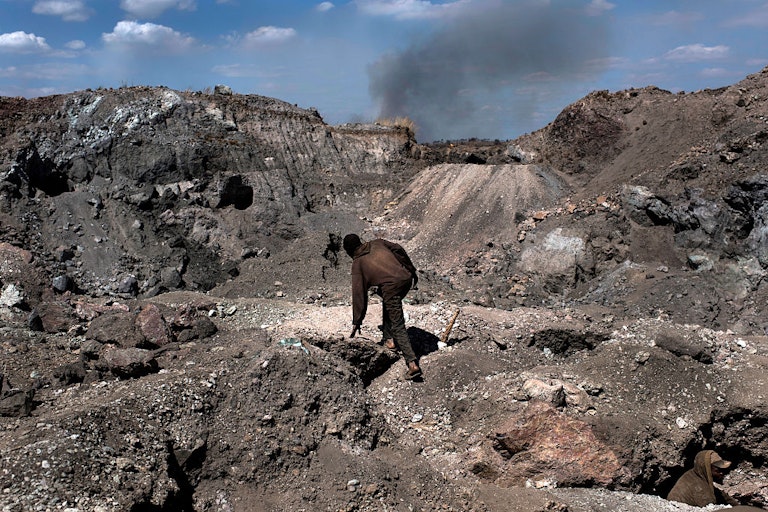
The Democratic Republic of Congo illustrated this. It has the world’s largest cobalt reserves. But weak government and persistent conflict have made it difficult to enforce mining codes. Artisanal and industrial mining practices cause severe water pollution and deforestation.
Similarly, Equatorial Guinea has an economy almost entirely dependent on oil. Producing more oil is seen as more important than meeting environmental standards. Transparency and accountability are poor.
The findings suggest that the environmental impact of Chinese involvement is not fixed. It hinges on whether African states have the institutional capacity to manage extraction responsibly.
Trade matters too, but governance still determines outcomes
Over the last two decades, China-Africa trade has rocketed. It shot up from US$10 billion in 2000 to $348 billion in 2025.
China exports high-value manufactured goods like electronics and solar panels. African exports mainly raw materials.
South Africa, the DRC, Nigeria and Angola together account for nearly half of the continent’s total trade volume with China.
The research found that trade with China played a more mixed role than investment.
On its own, trade didn’t appear to cause widespread environmental degradation. But in countries with weak governance, soaring trade demand often reinforced unsustainable practices. The energy sector was a case in point.
Without the referees of strong institutions, the pressure to meet export quotas encouraged intensified, unregulated extraction.
South Sudan and Nigeria illustrate this well. Conflict or corruption compromised oversight. Massive demand for crude oil led to bypassed environmental audits and severe localised pollution.
This creates a resource trap. Angola, for example, values immediate trade revenue over long-term ecological health. This leaves local communities to bear the cost of degraded landscapes and contaminated water.
What African governments can do
Across all forms of economic engagement, one factor shaped the outcome: governance quality.
The findings point towards what’s needed.
Firstly, stronger environmental regulation and enforcement.
Secondly, clear standards, independent oversight bodies and well-resourced regulatory agencies.
Thirdly, environmental safeguards in investment agreements. As part of project approvals, governments can require:
- environmental restoration plans
- transparent reporting of environmental impacts
- community consultation.
Fourth, long-term resource management. Natural resources underpin energy security, biodiversity and future economic growth.
Fifth, transparency and public accountability. Open contracting, environmental disclosures and accessible data empower citizens and civil society to hold governments and investors to account.
Africa’s natural resources will become even more strategically valuable as global demand for minerals, energy and agricultural land continues to rise. Ensuring that this benefits African societies, rather than eroding their ecological foundations, will depend on one central factor: the strength of governance across the continent.
Vincent Tawiah, Assistant Professor in International Financial Reporting, Dublin City University
This article is republished from The Conversation under a Creative Commons license.
