

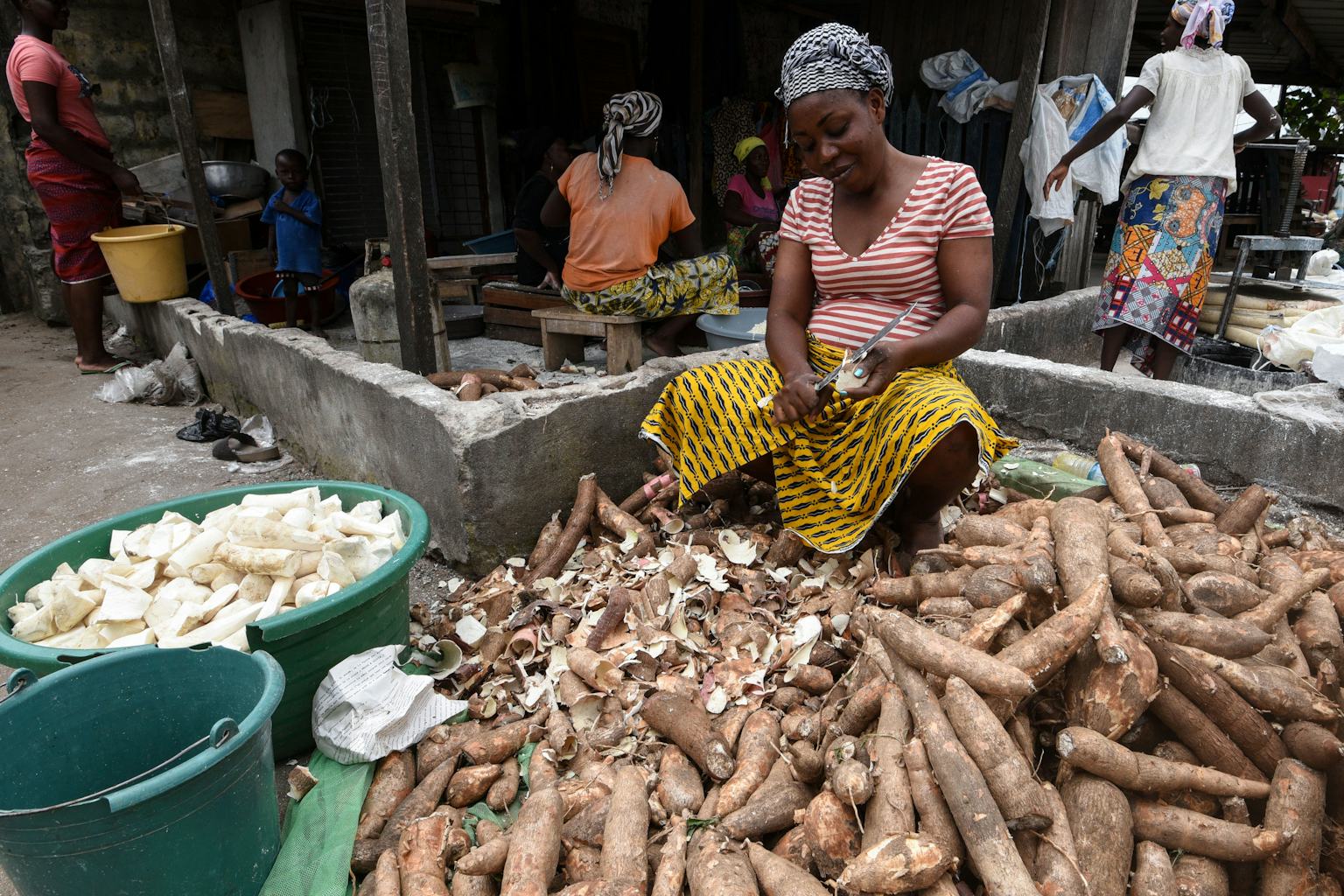
Cassava is a starchy, tuberous root, introduced to sub-Saharan Africa by Portuguese traders centuries ago. It is a nutrition lifeboat for over 800 million people worldwide.
Sub-saharan Africa contributes over 63% of the world’s total cassava production. Nigeria alone grows over 20% of the world’s cassava, which is also the continent’s second most important staple food crop. It can produce a reasonable harvest even when soil quality is poor, rainfall is low, or when it has not been fertilised much.
In Africa, cassava is now grown in humid and sub-humid tropical regions, including Nigeria, the Democratic Republic of Congo, Ghana, Tanzania, Uganda and Mozambique.
A warming climate is both the strength and the weakness of this crop. Cassava will be able to thrive in more places, but so will a deadly virus that kills the plant.
I was part of a team that aimed to predict and map where cassava and cassava brown streak disease might spread between now and 2080. We used computer models and climate data to do this.
Our results show that:
- Over half of Africa is currently suitable for cassava farming. This could grow to nearly two thirds of the continent’s land area in future.
- The disease already affects 33.7% of cassava production, but about 56.6% of the continent is at risk of the disease spreading.
This is because as the weather heats up, populations of whiteflies (Bemisia tabaci) expand. These spread the disease from plant to plant. This will be a threat to African food security.
Mapping the trends shows where people could plant disease-tolerant or resistant plant varieties as soon as possible.
Areas at the highest risk of disease outbreaks can be prioritised, along with the areas where it will be warm enough in future for cassava to grow. We suggest that national and international controls on the movement of cassava planting material must be tightly controlled to prevent the disease spreading.
Mapping where cassava can grow now and in a warmer future
Using scientific studies and data from the Global Biodiversity Information Facility, we set up a computer modelling approach that looked at where cassava and the disease have been found already, where the plant might expand under warmer conditions, and where the hotter climate would cause the disease to spread.
Our model identified that the environment in about 54.6% of Africa’s land area – about 16.2 million square kilometres – is currently suitable for cassava to grow, survive and extend. This includes countries such as South Sudan, Sudan, Somalia, Botswana and Zimbabwe, where there isn’t yet data on cassava.
Our model also showed that as the climate warms, a further 2.1 million square kilometres will become highly suitable. This area is concentrated in coastal west African nations including Guinea, Sierra Leone, Côte d’Ivoire, Ghana, Togo, Benin, Nigeria and Cameroon, as well as parts of central and east Africa.
Under future climate scenarios, both the suitable and highly suitable areas are projected to expand. Our research forecasts a 56%-60% increase in cassava-suitable habitats by 2050. Cassava will be able to flourish for the first time from the east coast of South Africa through Mozambique and into northern Madagascar.
This might seem positive for food security. Cassava’s resilience to global warming could help buffer African agriculture against climate shocks that threaten other staples like maize and beans.
However, this encouraging picture darkens considerably when considered alongside projections of future outbreaks of cassava brown streak disease.
Disease threat – is cassava safe?
We estimated the risk of the disease by identifying places where the disease already occurs and looking at places that have similar temperature, rainfall and environmental conditions. We then ranked these new places on their suitability for the disease.
We found that about 33.7% of Africa’s land area (10.2 million square kilometres) is currently at risk of cassava brown streak disease invasion. East Africa is the hotspot, particularly Tanzania, Uganda and south-east Democratic Republic of Congo.
Our model also shows that if the climate continues to warm as it is doing, 55%-57% of Africa’s land area will be vulnerable to the cassava disease by 2050.
The models even predict that the disease will spread west into regions currently free of it. This includes Côte d’Ivoire, Ghana, Benin, Nigeria and Cameroon – zones that are current cassava production powerhouses.
Nigeria is Africa’s largest cassava producer, producing over 60 million tons annually. It faces potential disease introduction through two entry points: the borders of DR Congo with Congo and the Central African Republic.
How the cassava brown streak disease spreads
Cassava grows best in areas where temperatures are fairly stable and warm (about 25°C-35°C). Very high or very low temperatures can stop its growth.
The disease spread depends on two factors. The first is cultivation practices. Farmers frequently reuse planting materials from previous seasons. If these are infected, the disease will spread to newly planted fields.
The second factor is the way in which the whitefly, which spreads the disease, adapts to climate change. Warm conditions make it easier for the insect to survive, reproduce and spread into new areas.
Our study found that the very climate changes that open new territories for cassava cultivation also create conditions favourable for its most destructive disease.
But we also found areas where cassava will thrive and the disease will remain constrained. The tropical rainforest and monsoon conditions found in central Democratic Republic of the Congo and zones along the Sahel belt may continue to limit disease outbreaks.
What needs to happen next
Our study proposes that heat tolerant and disease resistant cassava must be planted across all cassava production regions. Areas like the DRC and zones along the Sahel belt that are not suitable for the cassava brown streak disease must be planted with the improved cassava to create production zones relatively insulated from disease pressure.
Areas where cassava is already experiencing high disease outbreaks must be replanted.
This must be coupled with stricter national and international border controls on plant material movement.
Cassava’s resilience has underpinned African food security for centuries. Matching that natural resilience with human ingenuity and evidence-based policy will decide the crop’s future on the continent.
Geofrey Wingi Sikazwe, Lecturer in the Department of Mathematics, Physics and Informatics, University of Dar es Salaam
This article is republished from The Conversation under a Creative Commons license.
